How Long Does It Take to Put Up Scaffolding?
Published trade guides put a scaffold to one elevation of a two storey semi at roughly four to five hours for two scaffolders, or about half a day. A full perimeter takes longer because there is more of it. Larger commercial structures are built in stages over several days or weeks, because the trades following behind rarely need all of it at once.
Those erection figures come from published trade guides rather than from our own records, and we have said so rather than dress them up. The hire periods further down this page are ours, taken from completed jobs.
There are really two questions here, and people often mean the second one. How long does the gang take to build it, and how long will the scaffold be standing outside my house. The second answer is much longer than the first.
How long does erecting a scaffold take?
Erection time's driven by the size of the structure and how easily the materials reach it.
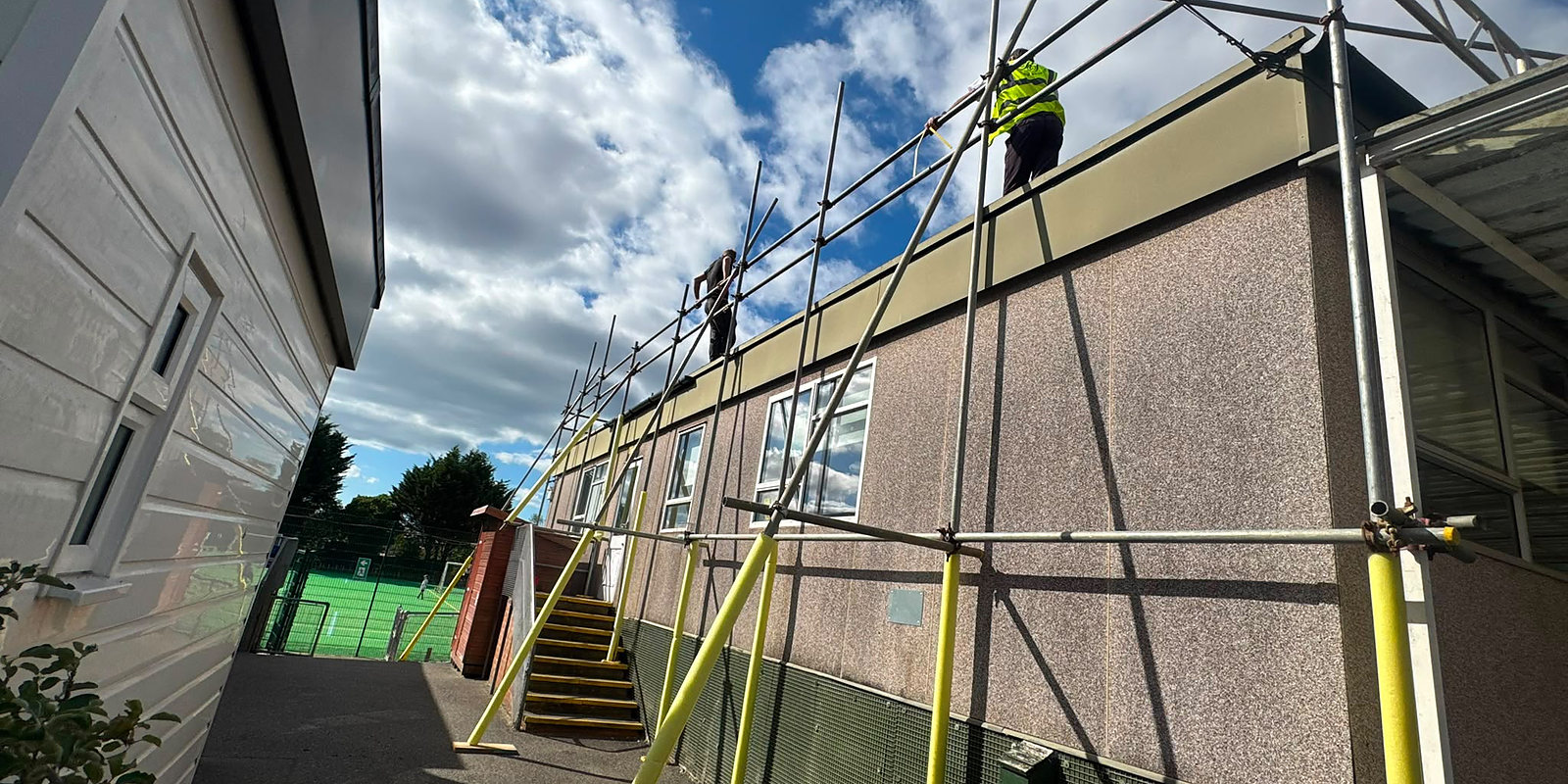
A straightforward run along one elevation goes up quickly. The same quantity of scaffold threaded along a narrow walkway between two buildings, or carried through a house because there is no side access, takes considerably longer. The scaffold is the same. The distance it has to be carried is not.
Three things slow erection down more than anything else:
No vehicle access. If the lorry can't get near the building, every tube and board is carried.
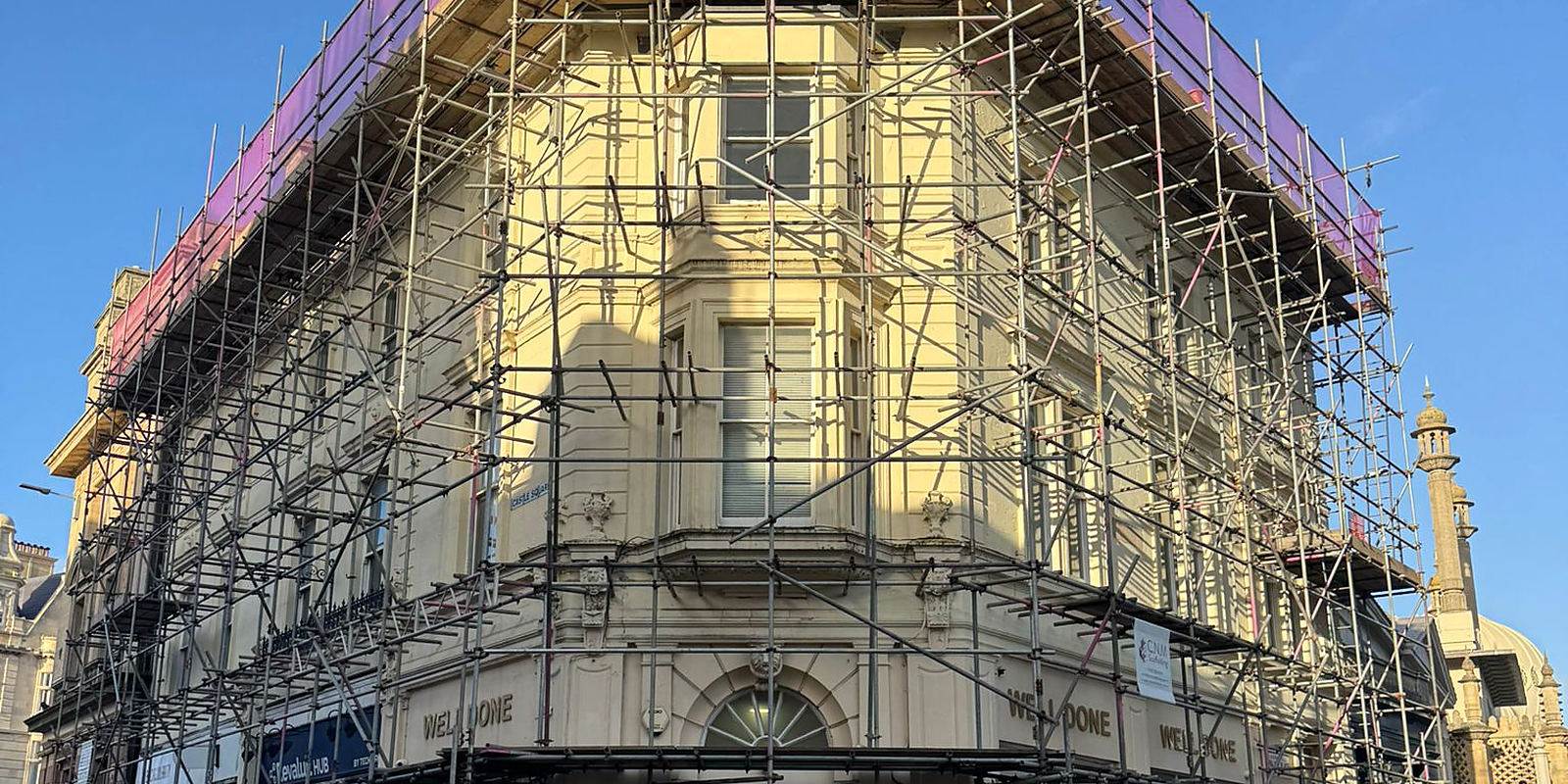
Working around people. On a live site the gang isn't working in an empty space. At Pavilion Buildings in Brighton the scaffold went up over trading shops on Castle Square, with banksmen posted at ground level for the whole erection to watch pedestrian movement and hold people back. That's slower by design, not by accident.
Designed structures. Anything bridged, hung or beamed takes longer than a standard configuration, because it is built to a drawing rather than to a pattern.
How long will scaffolding be up for?
This is the number that actually affects you, and it's set by the trade working off the scaffold rather than by the scaffolder.
Real durations from our own completed projects:
| Project | What the scaffold was for | How long it stood |
|---|---|---|
| Redstone Tyres, Arundel | Commercial works with full edge protection | 6 weeks |
| Victoria Court, Horsham | Roofing and exterior works | 6 weeks |
| The Eardley, Worthing | Repair and decoration to a full seafront facade | 8 weeks |
| The Old Dairy, Littlehampton | Phased roofing across several blocks | 8 weeks per block |
| Warblington School, Havant | Roof and interior maintenance | 8 weeks |
| Fordwater Building, Chichester High School | Roof repairs on a live school site | 12 weeks |
| Chichester University Chapel | Heritage restoration | 20 weeks |
| Beach House, West Sussex | Phased works with a designed temporary roof | 36 weeks |
The pattern's clear enough. A domestic re-roof or a decoration job is commonly four to eight weeks. A heritage restoration or a phased commercial programme runs for months.
Why does scaffolding stay up longer than the work takes?
Because the scaffold's got to be there before the trade starts and still there when they finish, and the gap at either end is rarely zero.
A roofer can't strip a roof on the morning the scaffold goes up. There is usually a day for the handover and the inspection, then the works, then a wait for the scaffold to come down once the trade has gone. Weather extends the middle, and a scaffold standing over a wet fortnight is still on hire.
The most common cause of a long hire is not the scaffolding at all. It's a works programme that slipped.
Can you speed scaffolding up?
To a point, and mostly before anyone turns up.
Clear the access. A side gate that opens, a driveway that is not blocked, and somewhere for the lorry to stop will save more time than anything else.
Book the scaffold to the trade, not to the calendar. If the roofer isn't starting for three weeks, a scaffold erected now is three weeks of hire nobody is using.
Tell the scaffolder everything that is in the way. A conservatory, a lightwell, a flat roof, overhead cables, a neighbour's fence. Surprises on the day cost more time than they do on the phone.
Confirm the hire period up front, because it is one of the biggest parts of what scaffolding costs. Most quotes carry a set period, often four or eight weeks, with a weekly rate after that. Knowing both numbers before you start is better than discovering the second one later.
What slows a scaffold down on the day?
| Condition | Effect on erection time |
|---|---|
| Lorry can park at the building | Baseline |
| Materials carried 20 metres or more | Noticeably longer |
| Materials carried through the house | Considerably longer |
| Working around a live school or shop | Slower by design, for good reason |
| Designed or bridged structure | Built to a drawing, not a pattern |
| Pavement licence required | Days or weeks before anyone arrives |
Does the type of job change the timescale?
It changes both halves of the answer.
A chimney scaffold on a terraced house is a small structure and a short hire. A full perimeter for parapet and guttering works is a bigger build and a longer hire, because the trade is working the whole way round rather than at one point.
Phased jobs behave differently again. At The Old Dairy in Littlehampton the roofing ran across several blocks, so the hire was quoted at eight weeks per block rather than as one figure for the site. At Pavilion Buildings in Brighton the job ran in two phases, with the second phase a different structure in a different place at the rear of the building.
If your works are phased, say so at quote stage. A scaffold priced as one hit and then delivered in stages is a conversation nobody wants halfway through.
How long before the trade can start?
Not the same day, in most cases.
A scaffold is handed over once it's complete and inspected, and the trade works off it from that point. On a straightforward domestic job that handover can happen the same afternoon. On a designed structure, or anything where the inspection flags something to put right, it's the following day.
Build that gap into your programme rather than assuming the roofer starts the moment the lorry leaves.
How much notice does a scaffolder need?
It depends on the job and the time of year, and the honest answer's that anything needing a council licence takes longer than anything that does not.
A scaffold on your own land can often be booked within days. A scaffold standing on a public pavement needs a licence from the local authority first, and that's a lead time outside the scaffolder's control.
If your job touches a footway, start that conversation early.
Talk to us about your programme
We work across West Sussex, Brighton and south Hampshire. Tell us what the works are and when the trade needs access, and we will tell you how long the scaffold takes to build and how long we would expect it to stand.
Written by The C.N.M Scaffolding team
Scaffolding contractors, West Sussex, Hampshire and Sussex
This guide was written from our own completed jobs rather than from a template. All of our operatives are CISRS certified. Where a figure comes from somewhere other than our own records, the source is named on the page.
Need a price for your job?
Tell us the address and what the works are, and we will come and look. No charge for the visit.
More Scaffolding Advice
How Much Does Scaffolding Cost in 2026?
Scaffolding is priced as one figure covering design, delivery, erection, the hire period and the dismantle. Here is what moves that figure, and what published guides say the range is.
Scaffold Inspection: The Rules and Who Is Responsible
A scaffold must be inspected before first use, then every seven days, and again after anything affecting its stability. The legal duty sits with the employer controlling the work.
Ready to Start Your Project?
Contact us today for a free, no-obligation quote