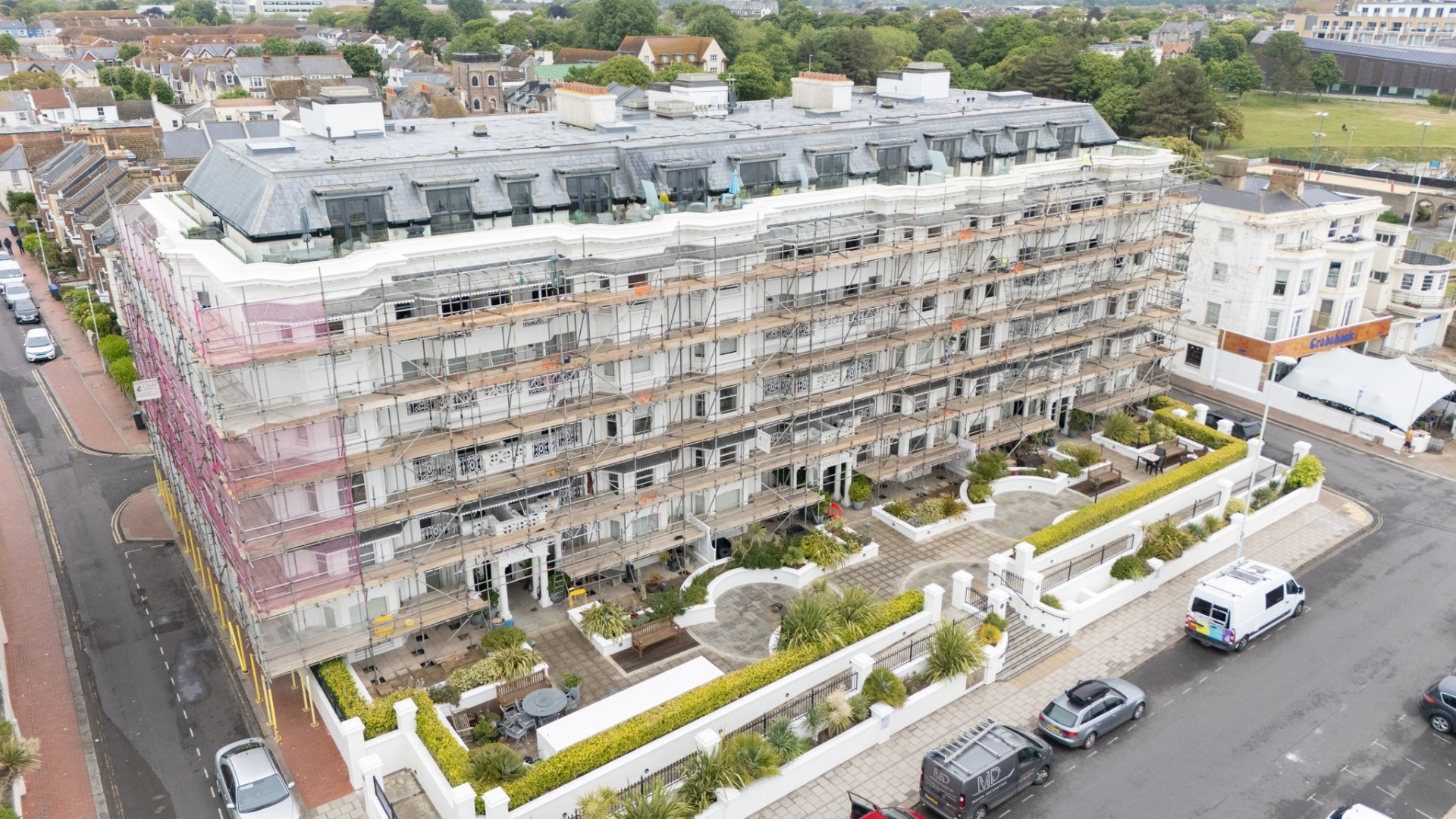
Scaffolding in Brighton
BN1, BN2, BN3. Regency terraces, tight Victorian streets and seafront exposure, handled properly.
Brighton Scaffolding At A Glance
| Postcodes | BN1, BN2, BN3 |
| Areas covered | Brighton, Hove, Portslade, Rottingdean, Saltdean, Woodingdean, Peacehaven |
| Conservation areas in the city | 34 designated |
| Highway licence | Applied for on your behalf, Brighton & Hove City Council |
| Licence notice period | 3 days for a new scaffold application |
| Licence fee | Set by the council, varies with scaffold size and duration |
| Local projects | New Build Roedean for CBG Construction, and a residential property in Brighton |
| Main services | Domestic access, commercial scaffolding, temporary roofs, new build, edge protection |
| Accreditation | CISRS certified, CHAS accredited, Scaffolding Association member |
| First step | Site visit or photos, then a written quote |
Why Brighton Is Harder to Scaffold Than Most Towns
Brighton has one of the most varied building stocks in the South East, and almost every part of it creates a constraint that doesn't exist in a standard suburban street.
The city has 34 designated conservation areas, which is why so much Brighton work comes with a constraint attached. The Regency and Georgian terraces around Kemp Town, Regency Square and Montpellier are frequently listed or sit inside one of them. The Kemp Town estate alone, designated in 1970, takes in Arundel Terrace, Lewes Crescent, Sussex Square and Chichester Terrace. The facades are decorative stucco, which is soft, original and expensive to repair. Where a tie goes, and whether it can go there at all, is decided before anyone loads a van. Parts of the city also carry Article 4 directions, which remove permitted development rights and change what can be done without consent.
The Victorian streets through Preston, Fiveways and Hanover are dense terraces with limited rear access and party wall constraints. Getting a scaffold up often means working out how to reach a side elevation between two buildings barely a metre apart, and how to get the materials in when the street is fully parked by eight in the morning.
The seafront brings wind and salt air that changes the design rather than just the maintenance cycle. Exposure means more ties, different sheeting decisions and structures secured for conditions that inland work never sees.
And parking is a genuine engineering problem here, not an inconvenience. Suspending bays, sequencing deliveries and getting a wagon to the kerb on a controlled parking street all have to be planned before the start date, not discovered on the morning.
How We Handle Each Property Type
On listed buildings and conservation area properties, the design starts from what the fabric will accept. Ties are planned around original stucco and ornamental detail rather than drilled wherever it's convenient, and where fixing into the facade isn't acceptable the structure is designed to stand independently instead.
On terraced streets, the constraint is access and neighbours. That means agreeing what can be reached from the front, what needs rear or side access, and where party wall considerations affect the design. It also means being straight with you about what's possible before you book a roofer.
On seafront properties, the design accounts for wind loading and exposure rather than treating the elevation as standard. More ties, considered sheeting, and a structure specified for the conditions it will actually stand in.
On new build and development sites, it's progressive scaffolding raised in phases alongside the build, coordinated with every other trade on site.
Scaffolding in Hove
Hove is a different job from Brighton and it's worth separating the two, because the stock and the constraints don't match.
Where central Brighton is tight terraces and steep streets, Hove is wide Victorian and Regency avenues built on a grander scale. Brunswick Town, The Avenues, Cliftonville and the Willett Estate are all conservation areas, and between them they cover a large share of the properties people ring us about.
Adelaide Crescent sits inside Brunswick Town and is a good example of why Hove needs planning rather than assumption. The crescent gardens run one to two metres below the surrounding streets, so base levels, standard heights and how you get materials to the property all change depending on which side you're working from. Albany Villas in Cliftonville, and the mansion blocks and mews through The Avenues, each bring their own access questions.
The buildings are mostly tall stucco-fronted terraces and mansion blocks, so more lifts and longer programmes, with the same care around original detail. The compensation is that Hove's wider streets usually make access and delivery easier than Hanover or Fiveways.
Two Brighton Projects
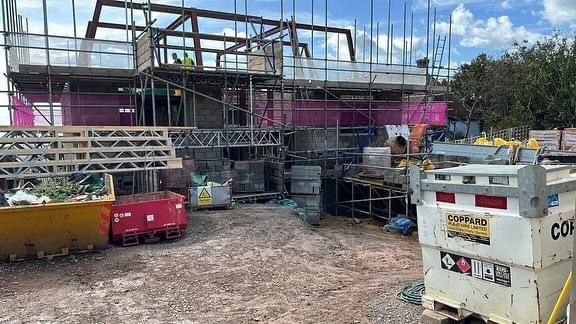
New Build, Roedean
New build residential home for CBG Construction
View ProjectWe were appointed by the main contractor to scaffold a single large residential home in Roedean. The site was compact, which meant close coordination with the other trades working alongside us and a design that gave everyone access without anyone blocking anyone else.
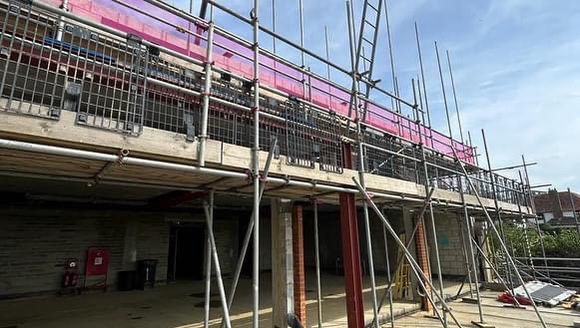
Residential Property, Brighton
Chimney access and front elevation repair
View ProjectAn independent scaffold providing chimney access, with fully boarded lifts to the front elevation for decoration and repair work. A straightforward domestic job of exactly the kind Brighton's terraced stock generates constantly.
"Professional company who deliver what they promise. Great communication throughout and the scaffolding was erected safely and efficiently. Can't fault them."
Get a Free Scaffolding Quote
No project is too big or too small. Contact us today for a free, no-obligation quote for your scaffolding needs in Brighton.
Commercial Scaffolding in Brighton
Brighton has a substantial commercial property sector, from the independent shops and restaurants of the Lanes and North Laine to larger retail and hospitality venues along the seafront and Western Road.
We provide commercial scaffolding for shop and restaurant refurbishments, hotel and hospitality maintenance, office building access, educational institutions, healthcare facilities, and mixed-use development projects. Our experience includes working on occupied commercial premises where maintaining access for businesses and their customers during the scaffolding period is essential.
Brighton's education sector, including the University of Sussex, University of Brighton, and numerous schools, also generates regular demand for scaffolding during maintenance and improvement programmes.
Our Scaffolding Services
Comprehensive scaffolding solutions tailored to your specific project requirements
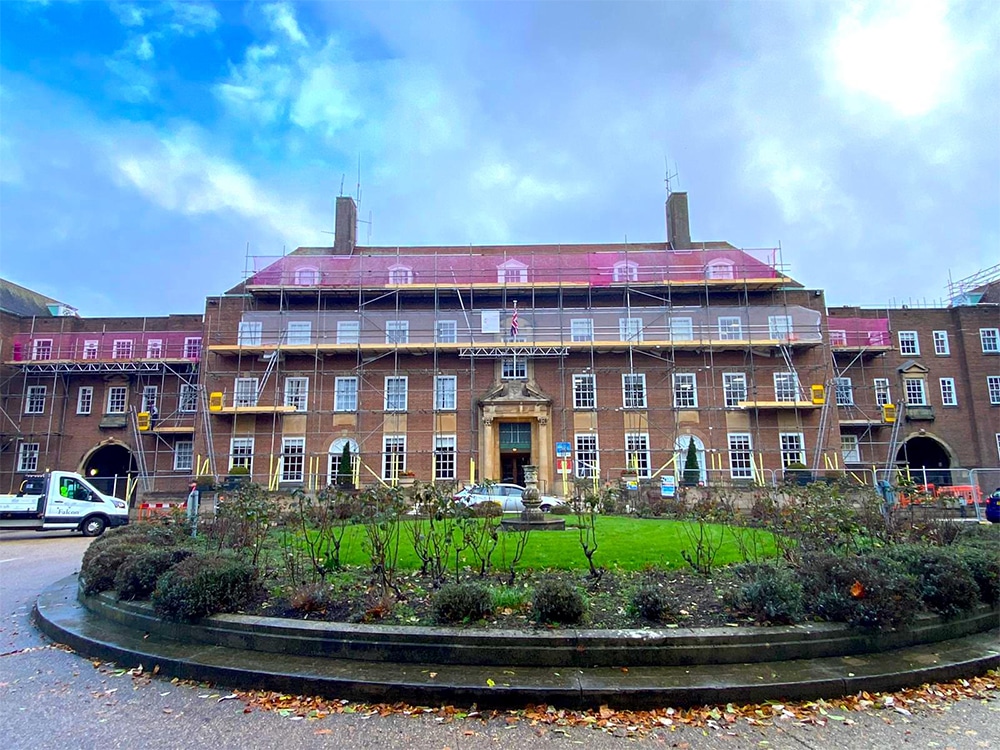
Commercial Scaffolding
Scaffold solutions for shops, hotels, schools, churches and occupied buildings
Learn More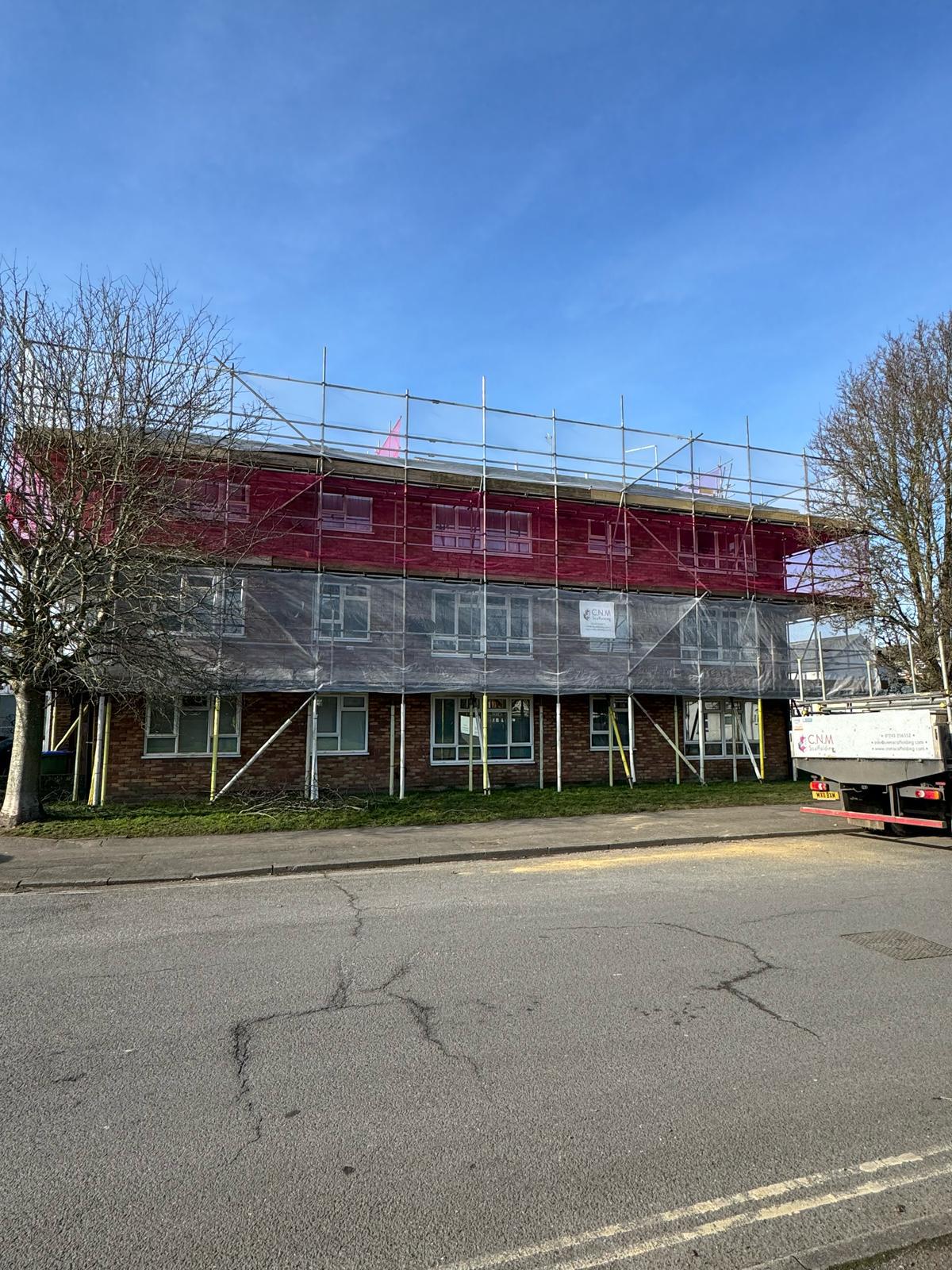
Domestic Scaffolding
Safe access for home repairs, extensions, roof work and loft conversions
Learn More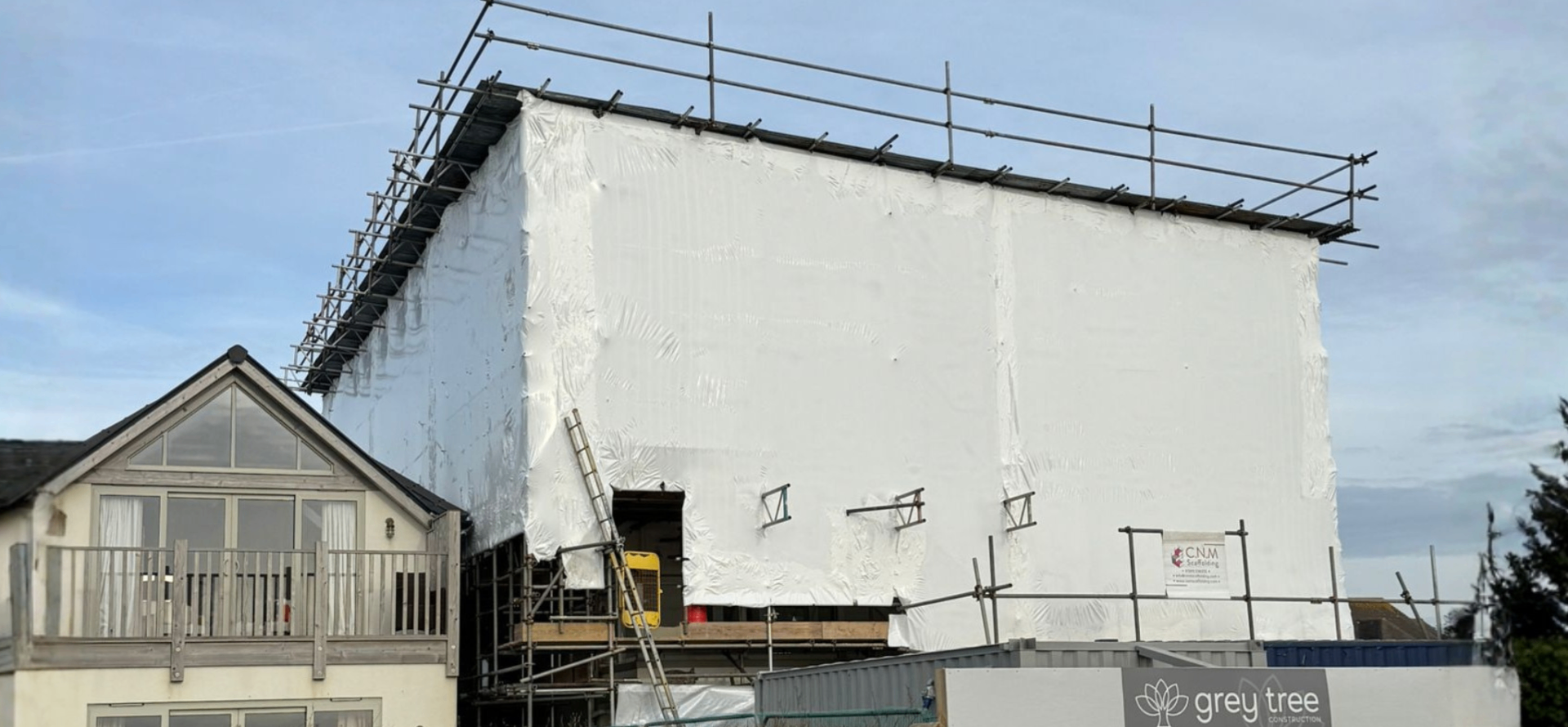
Temporary Roofs
Weather protection enabling construction work to continue year-round
Learn More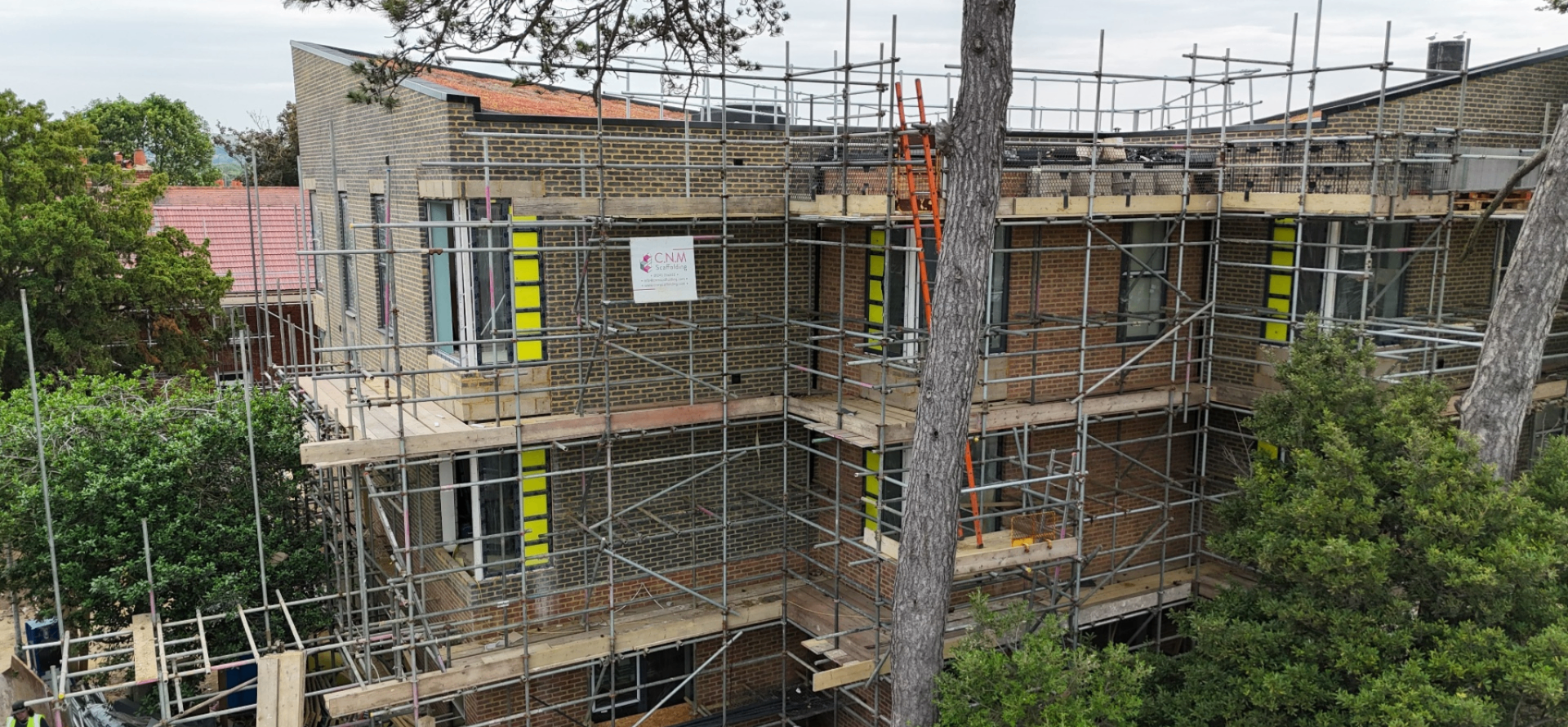
New Build Scaffolding
Progressive scaffolding for housing developments and construction sites
Learn More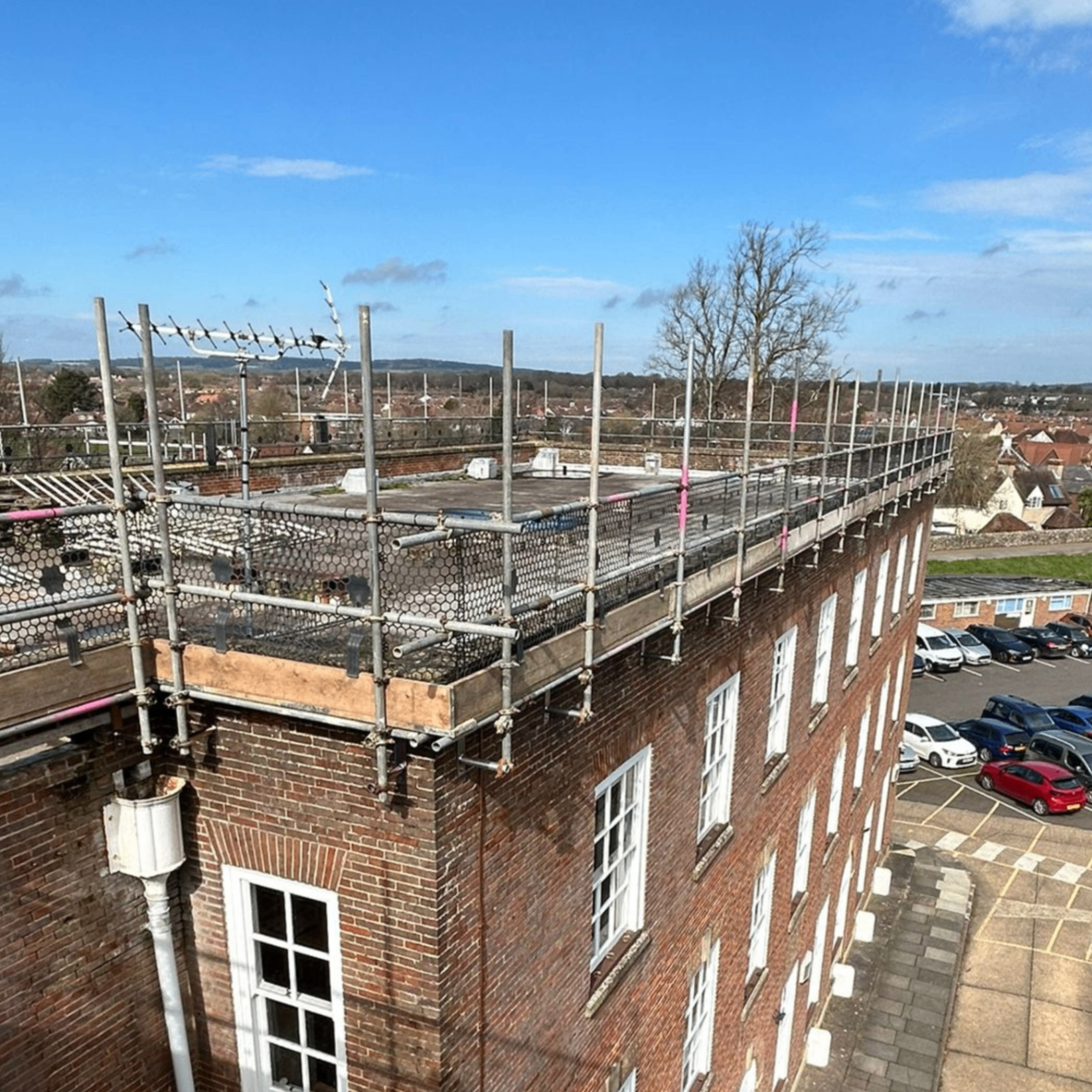
Edge Protection & Handrails
Fall prevention systems compliant with working at height regulations
Learn More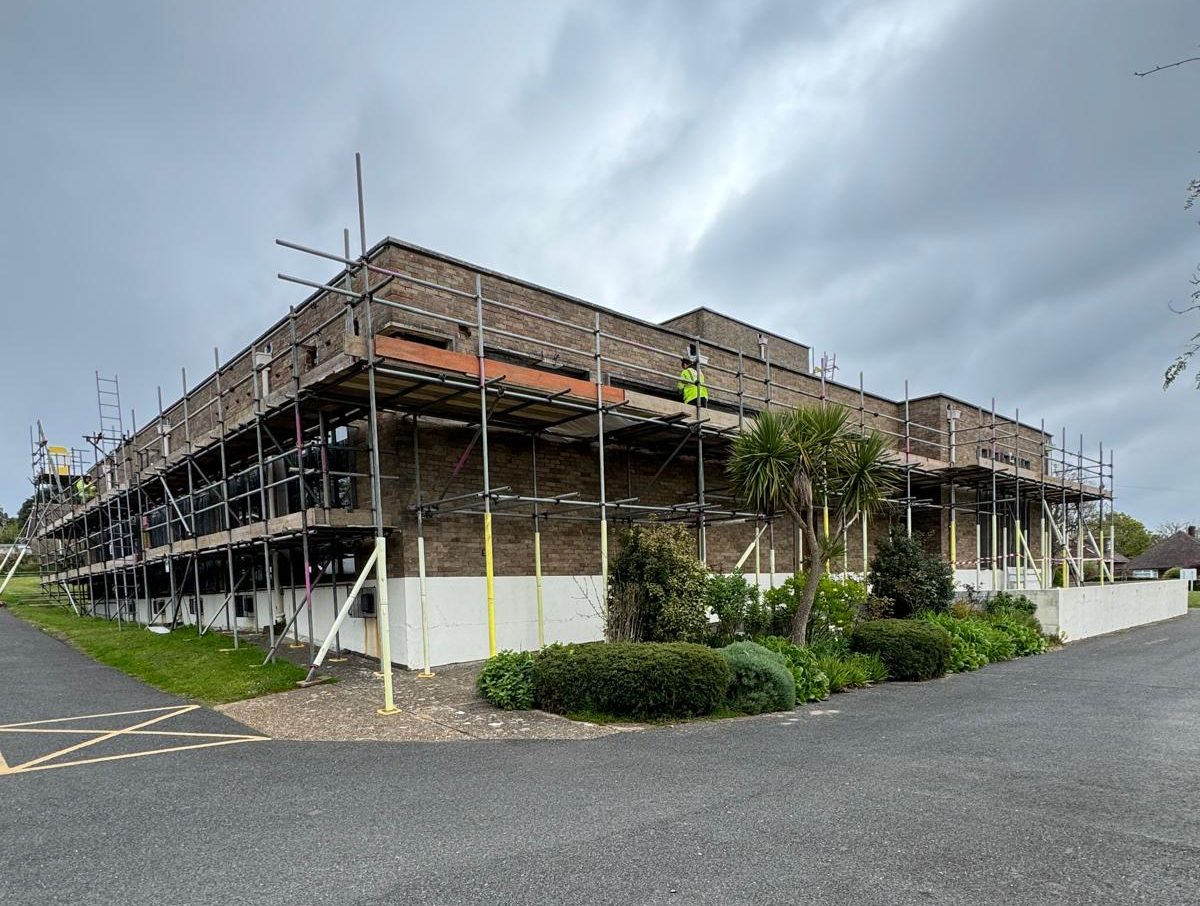
Safe Access Scaffolding
Reliable access for maintenance, repairs and restoration projects
Learn More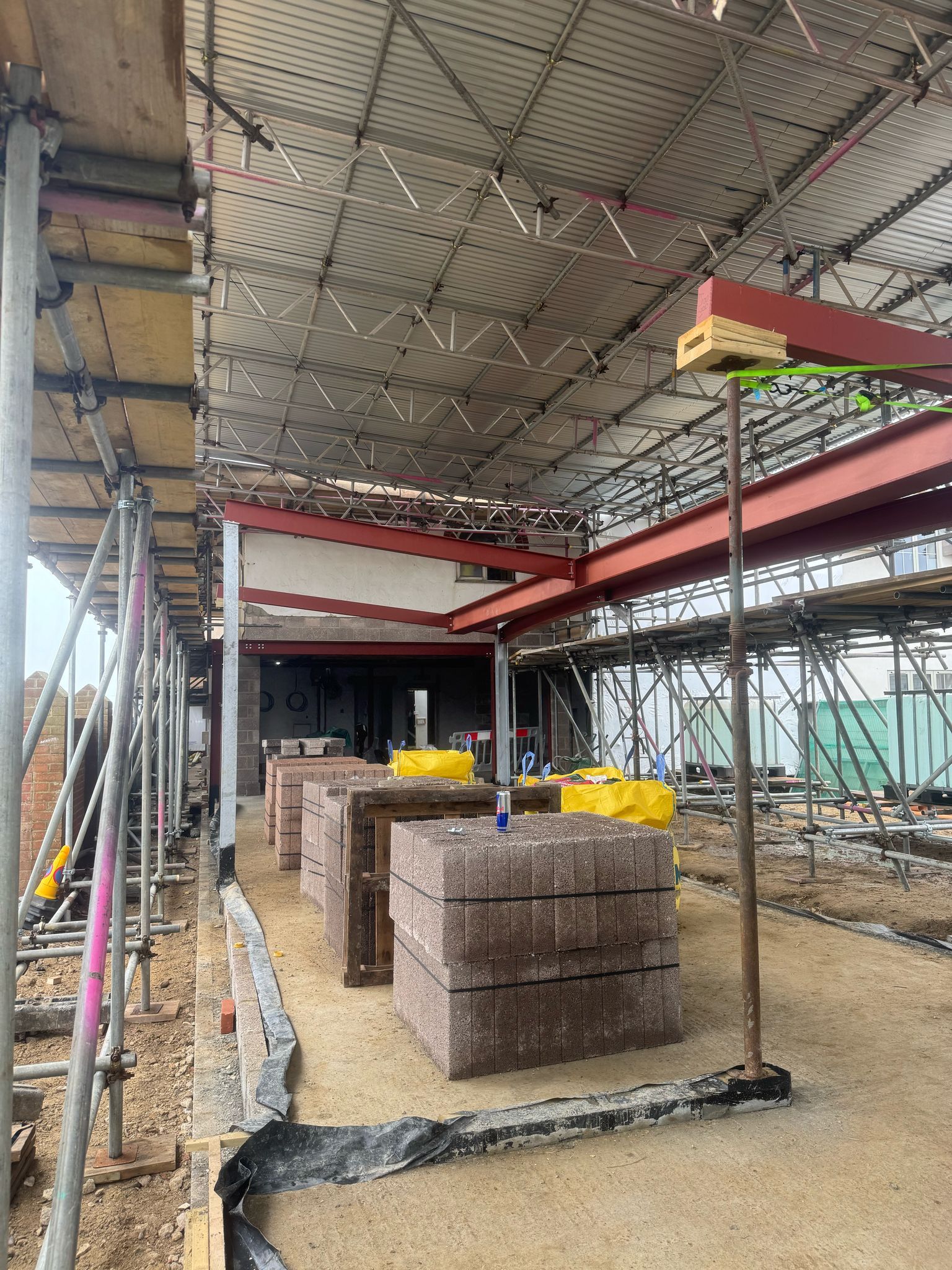
Hoist & Lifting Solutions
Loading bays, material handling and site logistics support
Learn More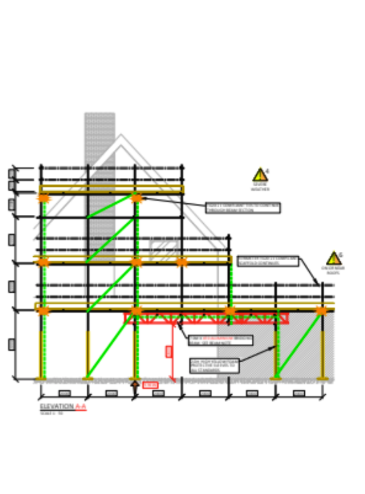
Design & Calculations
Engineering designs, drawings and calculations for complex structures
Learn MoreScaffolding Licences in Brighton and Hove
Brighton and Hove is a unitary authority, so unlike most of Sussex one council handles both planning and the highway. Simpler than West Sussex, stricter conditions.
The council asks for three days' notice on a new scaffold application. Anything left on the highway for more than 24 hours counts as scaffolding under their conditions, so a short job isn't exempt.
Applying after the scaffold is already up triggers a retrospective licence surcharge. It's an avoidable cost and it comes up more often than it should, usually because someone assumed the licence could follow the erection date.
The council requires £10 million of public liability insurance to work on the highway. That's a higher bar than many towns and it quietly rules out some contractors. Worth asking any scaffolder for their certificate before you book, in Brighton more than anywhere.
The licence also has to be renewed before it expires. Leaving a scaffold up past the expiry date without written permission breaches the conditions, so the end date matters as much as the start.
There's a licence fee too, set by the council and varying with the size of the scaffold and how long it stands. We confirm the current figure when we quote so it isn't a surprise on the invoice.
We apply on your behalf, build the notice period into the quote rather than discovering it later, and tell the council when the scaffold comes down.
Temporary Roofs and Weather Protection
Brighton work that runs through winter often needs more than access. A temporary roof keeps a property watertight while the permanent roof is off, which matters on a seafront city where a re-roof can otherwise sit waiting on weather for weeks.
We build temporary roof structures for re-roofing, fire and water damage reinstatement, and any job where the building has to stay dry and usable while work goes on above it.
Storm Damage and Emergency Scaffolding
Brighton and Hove take weather straight off the Channel, and the exposed seafront stock feels it first. Every winter brings slipped tiles, stripped ridge lines, chimneys that have moved and water finding its way in.
Emergency work isn't the same job as planned access. The building usually has to be made safe before anyone can properly assess it, and on a listed or stucco-fronted property that has to happen without causing more damage than the storm did.
If you've got storm damage in Brighton or Hove, ring rather than email. Tell us how exposed the property is and what's already come loose, and we'll tell you when we can get a crew to you.
Areas & Postcodes We Cover
Areas Nearby
We work across BN1, BN2 and BN3, covering Brighton, Hove, Portslade, Rottingdean, Saltdean, Woodingdean and Peacehaven.
For neighbouring towns, see our pages on scaffolding in Worthing, Shoreham, Lewes and Littlehampton.
Postcodes
Brighton Scaffolding Questions
Get a Free Quote in Brighton
Ready to discuss your scaffolding requirements? Fill in the form and a member of our team will get back to you promptly with a free, no-obligation quote.
Ready to Start Your Project?
Contact us today for a free, no-obligation quote